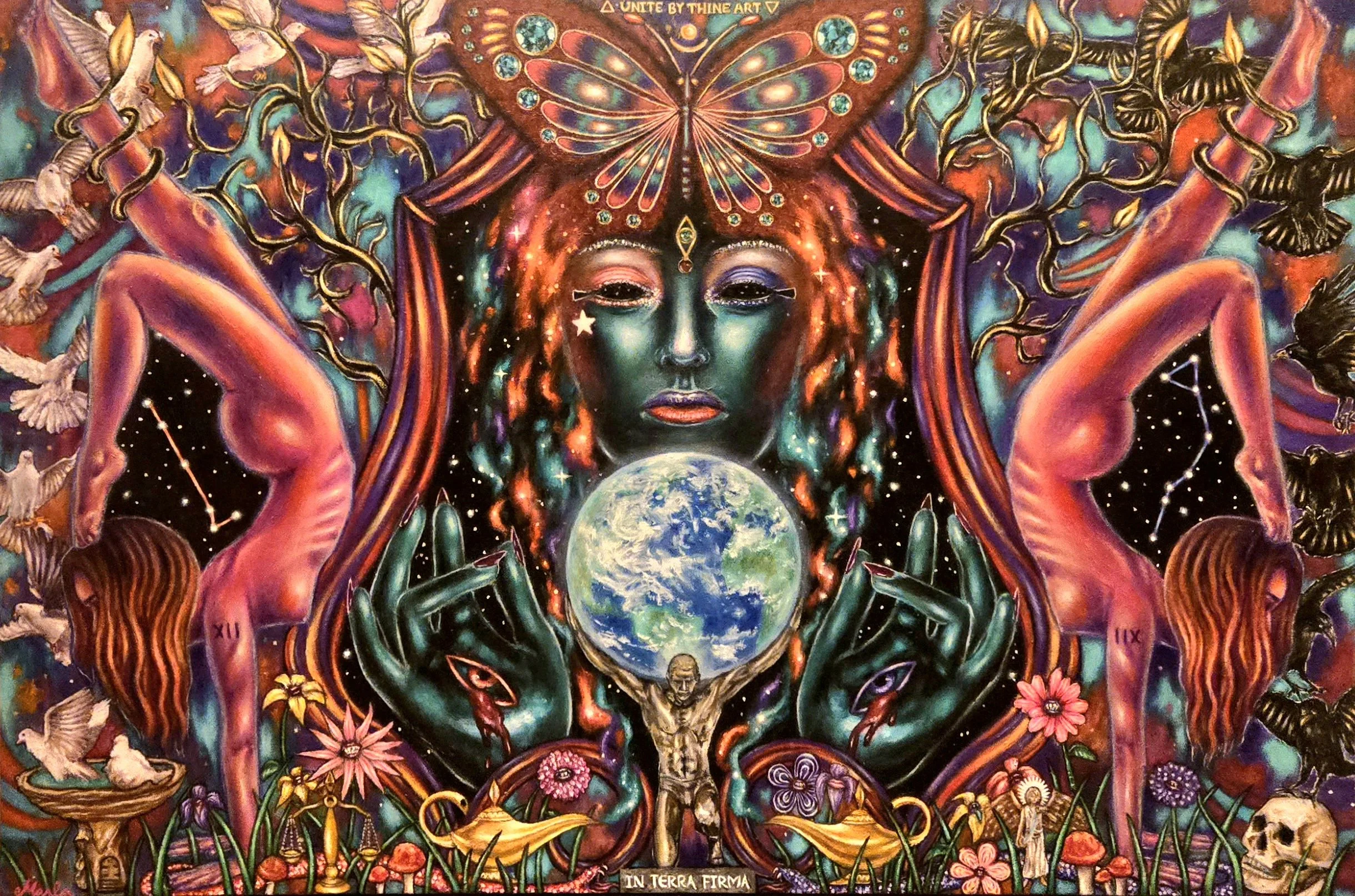
(36” x 24”) Oil on canvas 2019
This painting was inspired by one of the most mystical and life-altering spiritual awakenings of my life. An important part of that encounter involved ego dissolution, a feeling of losing one’s mind, and the long process of integration that followed. Creating this piece became a way for me to heal and to make sense of that experience.
At its core, the painting is an exploration of Temperance, the Major Arcana card known as Art in the Thoth tarot. Temperance represents balance, integration, and the harmonious blending of opposites. True harmony, as reflected here, is the alchemical work of polarized energies into a unified whole. In this way, embracing polarity can deepen self-awareness and spiritual growth.
The divine being in the center is supposed to be my cosmic interpretation of Gaia. Her hands encompass the Earth in Prithvi Mudra, a symbolic hand gesture of grounding that is connected to the Earth element. The stigmata on her palms reference Christ consciousness, while the above phrase “Unite by Thine Art” is drawn from The Book of the Law. Art, in this context, is directly linked to the Temperance card of the Rider-Waite tarot. The full quote, “But they have the half: unite by thine art so that all disappear," came to me as a synchronicity during the creation process and reflects the deeper spiritual aim of integration.
This concept is analogous to samadhi in Hindu and Buddhist traditions, a state of meditative union achieved through the balancing of dual energies. It reflects the alchemical process of individuation through becoming whole by integrating what once appeared separate.
The two women hanging upside down from the Tree of Life in Vrischikasana (Scorpion Pose) are mirrored images representing The Hanged Man in tarot, one upright and one reversed. They both represent surrender, sacrifice, and the balance of yin and yang. Each side also includes the divided constellation Ophiuchus, the serpent-bearer, symbolizing healing and transformation. Rather than a man carrying the serpent as seen in the original version of the constellation, I instead depicted Gaia as the integrative being between its dual halves of Serpens Caput and Serpens Cauda.
I incorporated white doves rising from a fountain, which symbolizes birth and spiritual renewal, while ravens descend toward a skull, which represent death and descent. They both illustrate the cyclical nature of existence where creation and destruction are inseparable stages in the evolution of consciousness.
Overall, this painting is supposed to be a rumination on the individuation process, during which I was forced to confront my own repressed shadow, making it feel as if I was descending into madness. By consciously achieving a balance of opposites, one moves closer to wholeness and a deeper understanding of life itself.